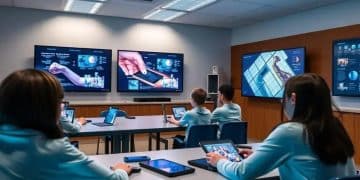
EdTech Revolution: 4 Innovative Learning Platforms Transforming US Classrooms by 2026

The EdTech Revolution: 4 Innovative Learning Platforms Transforming US Classrooms by 2026
The landscape of education is in a constant state of evolution, and at the forefront of this transformation is the burgeoning field of Educational Technology, or EdTech. As we hurtle towards 2026, the impact of EdTech learning platforms on US classrooms is not just significant, it’s revolutionary. These innovative tools are not merely supplementary; they are fundamentally reshaping how students learn, how teachers teach, and how educational institutions operate. The promise of personalized learning, enhanced engagement, and equitable access to high-quality education is being realized through the strategic integration of these cutting-edge platforms. This article delves deep into the EdTech revolution, highlighting four innovative learning platforms that are poised to make the biggest splash in US classrooms by 2026, and exploring the profound implications they hold for the future of education.
The Shifting Paradigm: Why EdTech Learning Platforms are Crucial Now More Than Ever
The past few years have accelerated the adoption of technology in nearly every sector, and education is no exception. The traditional classroom model, while foundational, is increasingly being augmented and, in some cases, redefined by digital tools. The demand for flexible, accessible, and highly engaging learning experiences has never been greater. This is where EdTech learning platforms step in, offering solutions that cater to diverse learning styles and paces, bridge geographical divides, and provide educators with unprecedented insights into student progress.
One of the primary drivers behind the rapid integration of EdTech is the recognition that a one-size-fits-all approach to education is no longer sufficient. Students come from varied backgrounds, possess different strengths, and learn in unique ways. Innovative learning platforms are designed to address this diversity, offering adaptive content, personalized pathways, and immediate feedback. This level of individualization was once a distant dream, but with advancements in artificial intelligence and data analytics, it is now a tangible reality within many EdTech solutions.
Moreover, the skills required for success in the 21st century workforce are shifting. Beyond rote memorization, critical thinking, problem-solving, collaboration, and digital literacy are paramount. EdTech learning platforms are uniquely positioned to cultivate these skills by providing interactive, project-based, and collaborative learning environments. They encourage students to explore, experiment, and construct knowledge actively, rather than passively receiving information. The move towards these dynamic learning experiences is a testament to the transformative power of the EdTech revolution.
Key Characteristics of Transformative EdTech Learning Platforms
Before we dive into specific examples, it’s essential to understand what makes an EdTech learning platform truly transformative. It’s not just about digitizing textbooks or offering online quizzes. The most impactful platforms share several key characteristics:
- Personalization and Adaptivity: They adjust content and pace to individual student needs, providing tailored learning paths.
- Engagement and Interactivity: They utilize gamification, multimedia, and collaborative tools to keep students actively involved.
- Data-Driven Insights: They provide valuable analytics to teachers, helping them understand student performance and inform instructional decisions.
- Accessibility and Equity: They strive to make high-quality education available to a wider audience, regardless of location or socioeconomic status.
- Seamless Integration: They integrate smoothly with existing school systems and curricula, reducing friction for educators.
- Focus on 21st-Century Skills: They promote critical thinking, creativity, communication, and collaboration.
These characteristics form the bedrock of the most promising EdTech learning platforms that are set to redefine US classrooms by 2026. The platforms we will explore embody many, if not all, of these attributes, demonstrating their potential to usher in a new era of educational excellence.
Platform 1: Adaptive Learning Systems with AI Tutors
The Rise of Personalized Pathways in EdTech Learning Platforms
One of the most significant advancements in the EdTech revolution is the emergence of sophisticated adaptive learning systems, often powered by artificial intelligence (AI). These platforms are designed to understand each student’s unique learning profile – their strengths, weaknesses, preferred learning styles, and even their emotional state – and then dynamically adjust the educational content and instructional strategies accordingly. Imagine a virtual tutor that is always available, infinitely patient, and perfectly attuned to the individual needs of every student. This is the promise of AI-driven adaptive learning platforms.
These EdTech learning platforms utilize complex algorithms to analyze student performance in real-time. If a student is struggling with a particular concept, the system can provide additional explanations, different examples, or alternative learning activities until mastery is achieved. Conversely, if a student demonstrates proficiency, the platform can accelerate their learning by introducing more advanced topics or challenging problems. This fluid adjustment ensures that students are always working within their zone of proximal development, preventing both boredom and frustration.
By 2026, we anticipate these AI-powered adaptive learning systems becoming a cornerstone of US classrooms. They will free up teachers from the arduous task of creating individualized lesson plans for every student, allowing them to focus on higher-level instruction, mentorship, and fostering a supportive learning environment. The data generated by these platforms will also provide teachers with invaluable insights, highlighting common misconceptions, identifying students who need extra support, and tracking progress over time. This data-driven approach is a game-changer for educational efficacy.
The impact on student outcomes is profound. Students using these EdTech learning platforms often report increased motivation, deeper understanding of concepts, and improved academic performance. The ability to learn at one’s own pace, revisit challenging material without judgment, and receive immediate, constructive feedback creates a highly effective and empowering learning experience. As AI technology continues to advance, the sophistication and effectiveness of these adaptive learning tutors will only grow, further solidifying their role in the future of education.
Platform 2: Immersive Virtual and Augmented Reality (VR/AR) Learning Environments
Bringing Learning to Life with Advanced EdTech Learning Platforms
Beyond traditional screens, the next frontier in EdTech learning platforms lies in immersive technologies: Virtual Reality (VR) and Augmented Reality (AR). These technologies are rapidly moving beyond gaming and entertainment, finding powerful applications in educational settings. By 2026, expect to see VR and AR becoming increasingly integrated into US classrooms, transforming abstract concepts into tangible, interactive experiences.
Imagine dissecting a frog in a virtual lab without the need for actual specimens, exploring ancient Roman cities as if you were truly there, or walking through the human circulatory system from the inside out. VR EdTech learning platforms offer unparalleled opportunities for experiential learning. They can transport students to places and times that would otherwise be inaccessible, allowing them to engage with content in a deeply immersive and memorable way. This level of engagement significantly enhances retention and understanding, making complex subjects more approachable and exciting.
Augmented Reality, on the other hand, overlays digital information onto the real world. Think of students pointing their tablets at a textbook page and seeing a 3D model of a molecule pop up, or using an AR app to visualize geological layers on a playground. AR EdTech platforms enrich the physical classroom environment, bringing digital content directly into the students’ immediate surroundings. This blend of the physical and digital creates dynamic learning opportunities that foster curiosity and exploration.
The benefits of VR/AR EdTech learning platforms extend beyond engagement. They can provide safe environments for practicing dangerous procedures, allow for collaborative exploration of virtual spaces, and cater to different learning styles by offering visual, auditory, and kinesthetic experiences. As the cost of VR/AR hardware decreases and content development tools become more accessible, these immersive platforms are set to become revolutionary tools in the EdTech landscape, fundamentally altering how students interact with and comprehend educational material. The spatial understanding and hands-on (albeit virtual) experience they offer are unmatched by traditional methods, making them a powerful force in the future of EdTech.
Platform 3: Collaborative Project-Based Learning Portals
Fostering 21st-Century Skills with Innovative EdTech Learning Platforms
Collaboration and project-based learning are widely recognized as effective pedagogical approaches for developing critical 21st-century skills. Innovative EdTech learning platforms are now specifically designed to facilitate these methods, even in remote or hybrid learning environments. By 2026, these collaborative portals will be integral to US classrooms, empowering students to work together on complex challenges, develop problem-solving abilities, and refine their communication skills.
These platforms often feature shared workspaces, real-time document editing, integrated communication tools (like video conferencing and chat), and project management functionalities. Students can form teams, assign roles, track progress, and contribute to shared projects regardless of their physical location. This mirrors the collaborative nature of modern workplaces, preparing students for future careers where teamwork and digital collaboration are essential.
Beyond simply providing tools for collaboration, the best EdTech learning platforms in this category also offer structured frameworks for project-based learning. They might include resources for defining project goals, guidelines for research and inquiry, rubrics for assessment, and mechanisms for peer feedback. Teachers can monitor group progress, provide targeted support, and assess not only the final product but also the collaborative process itself.
The impact of these platforms on student engagement is profound. When students are actively involved in solving real-world problems and creating tangible outputs, their motivation and sense of ownership increase dramatically. They learn to negotiate, compromise, delegate, and celebrate collective achievements. This hands-on, active learning approach, facilitated by advanced EdTech learning platforms, moves away from passive consumption of information towards active knowledge construction. As the emphasis on skills like critical thinking and innovation continues to grow, these collaborative project-based learning portals will play an increasingly vital role in shaping the educational experiences of students across the US.
Platform 4: Comprehensive Data Analytics and Predictive Learning Systems
Leveraging Data for Smarter Education through EdTech Learning Platforms
The sheer volume of data generated by digital learning activities represents an untapped goldmine for improving educational outcomes. By 2026, comprehensive data analytics and predictive learning systems will be among the most powerful EdTech learning platforms in US classrooms, offering unprecedented insights into student performance, instructional effectiveness, and curriculum design.
These advanced platforms collect and analyze data from various sources: student interactions with content, assessment results, time spent on tasks, collaboration patterns, and even emotional responses (through sentiment analysis in written communications). This data is then processed to provide educators with a holistic view of each student’s learning journey. Teachers can identify patterns, pinpoint areas where students are struggling, and even predict potential academic difficulties before they become significant problems.
For example, a predictive learning system might flag a student who is consistently spending less time on assignments, showing signs of disengagement, or repeatedly struggling with a specific type of problem. This early warning system allows teachers to intervene proactively, offering targeted support or adjusting their teaching strategies. This shift from reactive problem-solving to proactive intervention is a hallmark of the intelligent use of EdTech learning platforms.
Beyond individual student insights, these platforms also provide valuable data at the classroom, school, and district levels. Administrators can evaluate the effectiveness of different curricula, identify professional development needs for teachers, and allocate resources more efficiently. The ability to make data-driven decisions about education policy and practice is a powerful outcome of the EdTech revolution.
Ethical considerations surrounding data privacy and security are paramount, and the development of these EdTech learning platforms must prioritize robust safeguards. However, when implemented responsibly, these systems have the potential to revolutionize how we understand and improve the learning process, making education more efficient, equitable, and ultimately, more effective for every student.
The Broader Impact of EdTech Learning Platforms on US Classrooms by 2026
The integration of these four types of innovative EdTech learning platforms will have a ripple effect across the entire educational ecosystem. The role of the teacher, for instance, will evolve from being primarily a disseminator of information to a facilitator, mentor, and guide. With administrative tasks automated and personalized learning pathways managed by AI, teachers can dedicate more time to building relationships with students, fostering critical thinking, and addressing individual socio-emotional needs.
For students, the benefits are clear: more engaging content, personalized learning experiences, and the development of essential 21st-century skills. The classroom itself will transform into a dynamic, flexible space that accommodates various learning activities, from individual exploration in VR to collaborative project work. Learning will extend beyond the four walls of the school, becoming a continuous, lifelong process supported by accessible digital tools.
Furthermore, the EdTech revolution has the potential to significantly address issues of educational equity. By providing high-quality, personalized learning resources to students in underserved areas, these platforms can help bridge achievement gaps and ensure that all students have access to the same opportunities for success. The scalability of digital content means that expert instruction and rich learning materials can reach millions, democratizing access to education in an unprecedented way.
However, the successful implementation of these EdTech learning platforms requires more than just acquiring the technology. It necessitates ongoing professional development for educators, robust technical infrastructure, and a thoughtful pedagogical approach that integrates technology seamlessly into learning objectives. It also requires a commitment from educational leaders to embrace innovation and foster a culture of continuous improvement.
Challenges and Considerations for the Future of EdTech
While the future painted by these innovative EdTech learning platforms is bright, it is not without its challenges. Ensuring equitable access to technology and reliable internet connectivity remains a significant hurdle, particularly in rural and low-income communities. The digital divide must be addressed to ensure that the EdTech revolution benefits all students, not just those in well-resourced areas.
Another crucial consideration is the ongoing professional development of educators. Teachers need adequate training and support to effectively integrate new EdTech learning platforms into their teaching practices. This goes beyond technical proficiency; it involves understanding how to leverage these tools to enhance pedagogy and achieve specific learning outcomes. Without this investment in human capital, even the most advanced technologies will fall short of their potential.
Data privacy and student well-being are also paramount concerns. As EdTech learning platforms collect more data, robust ethical guidelines and security measures must be in place to protect student information. Furthermore, educators and parents must be mindful of screen time and ensure that technology use is balanced with other forms of learning and social interaction.
Finally, the rapid pace of technological change means that educational institutions must be agile and adaptable. What is cutting-edge today may be commonplace tomorrow. Therefore, a commitment to continuous evaluation, research, and adaptation will be essential to harness the full power of EdTech learning platforms in the long term.
Conclusion: The Dawn of a New Educational Era with EdTech Learning Platforms
The EdTech revolution is not a distant possibility; it is happening now. By 2026, the four types of innovative learning platforms discussed – AI-powered adaptive learning, immersive VR/AR environments, collaborative project-based portals, and comprehensive data analytics systems – will have fundamentally transformed US classrooms. They promise a future where education is more personalized, engaging, equitable, and effective than ever before.
These EdTech learning platforms are more than just tools; they are catalysts for a paradigm shift in how we approach teaching and learning. They empower educators to be more effective, equip students with the skills they need for the future, and open up unprecedented possibilities for access and innovation. As we move forward, fostering collaboration between technology developers, educators, policymakers, and communities will be key to realizing the full potential of these transformative platforms and truly ushering in a new era of educational excellence for all.