Medicare Part D 2026: Key Changes & Prescription Drug Savings

Navigating the complexities of healthcare can be daunting, especially when it comes to prescription drug coverage. For millions of Americans, Medicare Part D plays a critical role in managing medication costs. As we look ahead to 2026, significant changes are on the horizon for Medicare Part D, promises that aim to make prescription drugs more affordable and accessible. These updates, stemming from the Inflation Reduction Act (IRA) of 2022, represent one of the most substantial overhauls to the program since its inception in 2006. Understanding these modifications is not just beneficial; it’s essential for beneficiaries, caregivers, and healthcare providers alike to plan effectively and maximize the benefits available.
The year 2026 will usher in a new era for Medicare Part D, primarily characterized by a groundbreaking out-of-pocket spending cap, a redesigned benefit structure, and expanded eligibility for low-income subsidies. These changes are designed to provide much-needed financial relief for individuals with high prescription drug costs, particularly those managing chronic conditions. The current system can leave some beneficiaries vulnerable to exorbitant expenses once they reach the catastrophic phase. The forthcoming reforms aim to mitigate this risk, offering greater predictability and protection against unforeseen financial burdens.
This comprehensive guide will delve deep into the specifics of the Medicare Part D 2026 changes, breaking down what each update means for you. We’ll explore the implications of the new $2,000 out-of-pocket limit, how the restructured benefit phases will impact your spending, and who stands to gain the most from the enhanced low-income subsidies. Furthermore, we’ll provide practical strategies and actionable advice to help you prepare for these changes, ensuring you are well-equipped to make informed decisions about your prescription drug coverage. Staying informed now can lead to substantial savings and improved health outcomes in the future. Let’s embark on this journey to demystify the Medicare Part D 2026 landscape.
Understanding the Core of Medicare Part D 2026: The Inflation Reduction Act’s Impact
The foundation of the Medicare Part D 2026 changes lies firmly within the Inflation Reduction Act (IRA) of 2022. This landmark legislation was not solely focused on climate change and tax reform; it also contained significant provisions aimed at lowering prescription drug costs for Medicare beneficiaries. For years, advocates have called for reforms to address the rising price of medications, and the IRA represents a monumental step in that direction. Its impact on Medicare Part D is multifaceted, touching upon direct drug price negotiation, insulin cost caps, and, most notably for 2026, a complete overhaul of the Part D benefit structure.
Prior to the IRA, Medicare Part D beneficiaries faced a complex system with several phases, including the deductible, initial coverage, coverage gap (or ‘donut hole’), and catastrophic coverage. While the Affordable Care Act (ACA) introduced measures to gradually close the donut hole, beneficiaries with very high drug costs could still incur substantial out-of-pocket expenses in the catastrophic phase, where they were responsible for 5% of drug costs with no upper limit. This lack of a ceiling left many vulnerable to financial hardship, especially those requiring expensive specialty medications.
The IRA’s provisions for Medicare Part D 2026 are designed to fundamentally alter this landscape, providing greater financial predictability and protection. The changes are being implemented incrementally, with some aspects already in effect (like the $35 cap on insulin per month and zero cost-sharing for adult vaccines in 2023) and others, like the highly anticipated $2,000 out-of-pocket cap, rolling out in 2025 and 2026. These reforms are not just about capping costs; they are about redesigning the entire benefit to be more equitable and sustainable for beneficiaries.
One of the key motivations behind these changes was the recognition that high drug costs disproportionately affect vulnerable populations, including those with chronic illnesses, limited incomes, and multiple prescriptions. The IRA aims to alleviate this burden, ensuring that access to necessary medications is not hindered by an inability to pay. By empowering Medicare to negotiate drug prices and restructuring the benefit, the government is taking a more active role in controlling pharmaceutical expenditures, a move that is expected to have far-reaching positive effects on senior health and financial well-being.
Understanding the IRA’s intent and its phased implementation is crucial for grasping the full scope of the Medicare Part D 2026 changes. It’s a legislative effort to bring relief to millions, and knowing the backstory helps contextualize the forthcoming reforms and their potential impact on your healthcare journey.
The Game-Changer: $2,000 Out-of-Pocket Cap on Prescription Drug Costs (Effective 2025/2026)
Perhaps the most significant and eagerly awaited change for Medicare Part D 2026 beneficiaries is the introduction of a hard cap on out-of-pocket prescription drug spending. While this cap officially takes full effect in 2025, its implications will be fully realized in the redesigned 2026 benefit structure. Starting in 2025, beneficiaries will no longer have to pay 5% of their drug costs in the catastrophic phase. Instead, once their out-of-pocket spending reaches a certain threshold, their costs will drop to zero for the remainder of the year. For 2025, this threshold is projected to be around $2,000, and it will be inflation-adjusted in subsequent years, including 2026.
This $2,000 out-of-pocket cap is a monumental shift. Historically, beneficiaries with very high drug costs, particularly those on expensive specialty medications for conditions like cancer, multiple sclerosis, or rheumatoid arthritis, could face thousands, if not tens of thousands, of dollars in out-of-pocket expenses annually. The absence of a spending limit meant that even with insurance, a severe illness could lead to financial ruin. The new cap provides a much-needed safety net, ensuring that no matter how high their prescription drug costs are, beneficiaries will not pay more than $2,000 out of their own pocket in a given year.
It’s important to clarify what counts towards this out-of-pocket limit. The cap includes your annual deductible, your co-payments, and your co-insurance amounts for covered Part D drugs. It does not, however, include your monthly Part D plan premiums. This distinction is vital for accurate financial planning. While your premiums will still be a recurring expense, the actual cost of your medications will be capped once you hit the $2,000 threshold.
This change is expected to have a profound impact on millions of beneficiaries. Estimates suggest that hundreds of thousands of people who currently spend more than $2,000 annually on prescription drugs will see substantial savings. This financial relief can free up resources for other essential needs, reduce medical debt, and potentially improve adherence to critical medications, as cost becomes less of a barrier. For individuals managing multiple chronic conditions requiring expensive therapies, this cap offers unprecedented peace of mind and financial security.
Preparing for this cap involves understanding your current spending patterns and how they might shift. If you anticipate reaching or exceeding this threshold, knowing that your costs will cease after $2,000 can significantly influence your budgeting and healthcare decisions. This cap is not just a policy change; it’s a direct financial benefit that will reshape how many Americans access and afford their necessary medications under Medicare Part D 2026.
Redesigned Medicare Part D Benefit Structure (Effective 2025/2026)
Beyond the out-of-pocket cap, the Medicare Part D 2026 landscape will feature a completely redesigned benefit structure, which began its phased implementation in 2024 and will be fully realized by 2025 and 2026. This redesign aims to simplify the current multi-phase system and redistribute cost-sharing responsibilities among beneficiaries, plans, and drug manufacturers. The previous structure involved a deductible, initial coverage phase, coverage gap (donut hole), and catastrophic coverage. The new model streamlines these phases and significantly alters who pays for what, ultimately benefiting beneficiaries with high drug costs.
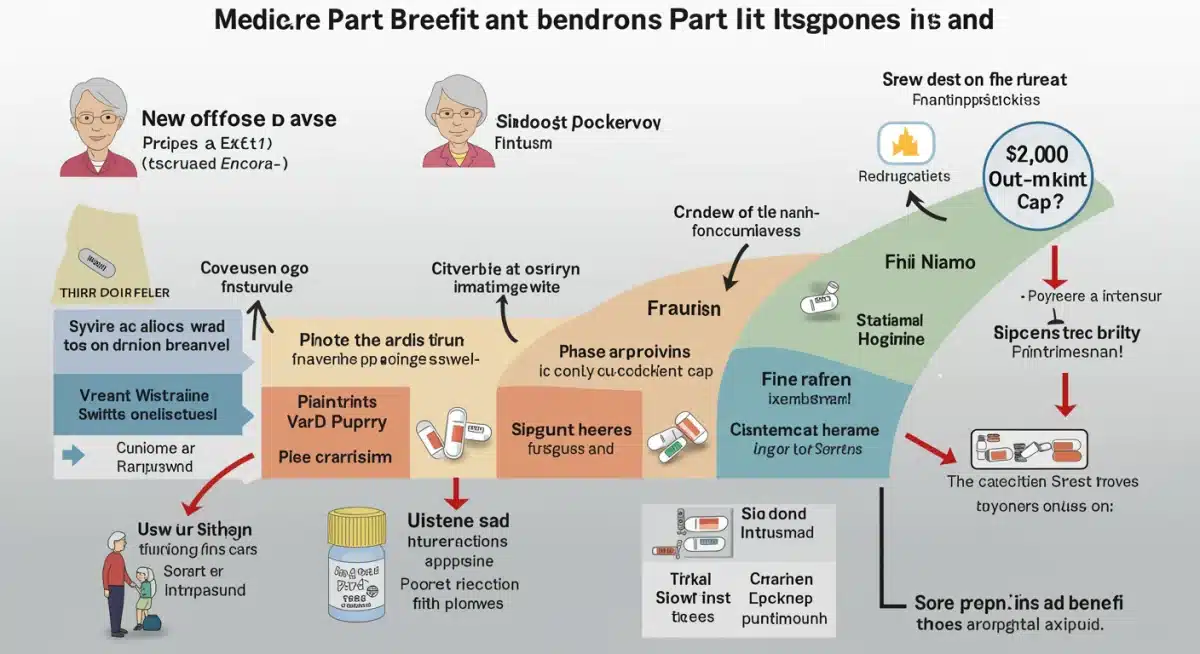
The new benefit design for 2025 and 2026 will essentially have three main phases, moving away from the complex four-phase system. While the exact thresholds for each phase are subject to annual adjustments, the core structure will be:
- Deductible Phase: Beneficiaries pay the full cost of their drugs until they meet their plan’s deductible. The IRA sets a maximum deductible, but plans can offer lower or no deductibles.
- Initial Coverage Phase: After meeting the deductible, beneficiaries pay a co-payment or co-insurance, while the plan covers the rest. What’s new is that drug manufacturers will also contribute a discount during this phase for certain high-cost drugs.
- Catastrophic Phase: This is where the most significant change occurs. Once a beneficiary’s out-of-pocket spending (including deductible and initial coverage phase costs) reaches the annual cap (e.g., $2,000 in 2025), they will pay nothing for covered Part D drugs for the remainder of the year. This eliminates the 5% co-insurance that beneficiaries previously paid in the catastrophic phase.
A crucial element of this redesign is the increased responsibility of drug manufacturers and Part D plans. In the catastrophic phase, drug manufacturers will be responsible for a higher percentage of drug costs (expected to be around 20%), and Part D plans will also bear a greater share (around 60%), leaving beneficiaries with zero cost-sharing once they hit the out-of-pocket limit. This shift is intended to incentivize manufacturers to keep drug prices in check and encourage plans to negotiate better deals, as they will have more financial exposure to high-cost drugs.
The elimination of the 5% co-insurance in the catastrophic phase is a direct response to the financial strain many beneficiaries experienced. It transforms the catastrophic phase from a period of continued high costs into a period of complete financial relief for those who reach the cap. This structural change means that beneficiaries will have a clearer understanding of their maximum annual exposure to prescription drug costs, allowing for better financial planning and reducing anxiety about unforeseen medical expenses.
Understanding this redesigned structure is key to predicting your potential costs under Medicare Part D 2026. It’s no longer just about meeting a deductible and navigating a donut hole; it’s about a clearer pathway to capped spending and significant relief for those who need it most. This change represents a more equitable distribution of costs and a stronger safety net for all Part D beneficiaries.
Expanded Low-Income Subsidies (LIS) (Effective 2024/2026)
Another pivotal enhancement within the Medicare Part D 2026 framework, with changes already beginning in 2024, is the expansion of the Low-Income Subsidy (LIS) program, often referred to as ‘Extra Help.’ This program provides financial assistance to Medicare beneficiaries with limited income and resources to help cover their Part D plan premiums, deductibles, and co-payments. Historically, individuals with incomes between 135% and 150% of the federal poverty level (FPL) received partial LIS benefits, meaning they still had some cost-sharing responsibilities.
The Inflation Reduction Act significantly expands eligibility for full LIS benefits. Starting in 2024, beneficiaries with incomes up to 150% of the FPL and who meet the program’s resource limits will qualify for full Extra Help. This means they will pay no premiums, no deductible, and have minimal, fixed co-payments for their covered prescription drugs. This expansion is a game-changer for hundreds of thousands of low-income seniors and individuals with disabilities, providing them with comprehensive prescription drug coverage that was previously out of reach.
The impact of this expansion cannot be overstated. For many, even small co-payments can be a barrier to medication adherence, leading to worse health outcomes and higher healthcare costs down the line. By eliminating these cost-sharing burdens for a broader segment of the low-income population, the expanded LIS program ensures that financial constraints do not prevent access to essential medications. This is particularly crucial for individuals managing chronic conditions who rely on multiple prescriptions.
Who Benefits from Expanded LIS?
- Individuals with incomes between 135% and 150% of the FPL: These individuals previously received partial subsidies but will now qualify for full Extra Help, resulting in significant savings.
- Those struggling with drug costs: Even if their income was slightly above the previous full LIS threshold, they may now qualify, offering substantial financial relief.
- Beneficiaries managing chronic illnesses: The removal of deductibles and co-payments will make it much easier to afford necessary, often expensive, long-term medications.
Applying for Extra Help is a straightforward process, typically managed through the Social Security Administration. Beneficiaries can apply online, by mail, or over the phone. It’s crucial for anyone who thinks they might qualify to investigate this benefit, as it can dramatically reduce prescription drug expenses. The expanded LIS program is a testament to the IRA’s commitment to making healthcare more equitable and affordable for all Medicare beneficiaries, laying a stronger foundation for the Medicare Part D 2026 framework.
Strategies to Prepare for Medicare Part D 2026
With significant changes coming to Medicare Part D in 2026, proactive preparation is key to maximizing your benefits and minimizing your out-of-pocket costs. Don’t wait until the last minute; understanding these shifts now allows you to make informed decisions about your coverage and financial planning. Here are several strategies to help you navigate the upcoming Medicare Part D 2026 landscape:
1. Review Your Current Prescription Drug Usage and Costs
Start by compiling a comprehensive list of all your current medications, including dosage and frequency. Track your annual out-of-pocket spending on prescriptions. This detailed understanding of your current drug profile and costs will be invaluable when comparing plans under the new structure. Pay particular attention to how close you come to the new $2,000 out-of-pocket cap. If you typically spend more, the 2026 changes will be especially beneficial for you.
2. Understand the New Benefit Phases
Familiarize yourself with the redesigned Part D benefit structure. While the specifics of deductibles and initial coverage co-pays will vary by plan, knowing that the catastrophic phase now means zero cost-sharing after the $2,000 cap is critical. This knowledge will empower you to better evaluate how different plans align with your anticipated drug needs and spending.
3. Explore Eligibility for Expanded Low-Income Subsidies (LIS)
If your income and resources are limited, even if you previously didn’t qualify for full Extra Help, re-evaluate your eligibility for the expanded LIS program. The increased income threshold (up to 150% of the FPL) means many more beneficiaries will qualify for substantial premium, deductible, and co-payment assistance. Contact the Social Security Administration to inquire about your eligibility and apply if you meet the criteria. This could be one of the most impactful ways to reduce your Medicare Part D 2026 costs.
4. Actively Participate in Annual Enrollment Period (AEP)
The Medicare Annual Enrollment Period (AEP), which runs from October 15th to December 7th each year, will be more crucial than ever leading up to 2026. During AEP, you can switch Part D plans or move from one Medicare Advantage plan to another. This is your opportunity to compare how different plans have adapted to the new benefit design and select the one that offers the best coverage for your specific medications at the lowest cost, factoring in the $2,000 out-of-pocket cap and any LIS benefits.
5. Utilize Medicare’s Plan Finder Tool
The official Medicare Plan Finder tool on Medicare.gov is an invaluable resource. During AEP, it will be updated with all the new plan details for the upcoming year. Input your medications, preferred pharmacy, and income information to get personalized plan comparisons that factor in the new Medicare Part D 2026 rules. This tool can help you identify the most cost-effective plan based on your unique needs.
6. Consult with a Medicare Expert
Consider seeking advice from a qualified Medicare counselor or an independent insurance agent specializing in Medicare. These professionals can help you understand the nuances of the Medicare Part D 2026 changes, compare plans, and ensure you’re making the best choices for your health and financial situation. They can also help clarify any questions about LIS eligibility or specific drug coverage.
7. Stay Informed About Drug Price Negotiations
While not a direct action for beneficiaries, staying aware of which drugs Medicare is negotiating prices for (a separate provision of the IRA) can indirectly affect your costs over time. These negotiations aim to lower the prices of some of the most expensive drugs, which could further reduce overall spending for both beneficiaries and the Medicare program. While the first negotiated prices take effect in 2026, their impact on your specific plan’s formulary and pricing will evolve.
By taking these proactive steps, you can confidently approach Medicare Part D 2026, ensuring you are well-prepared for the new landscape and positioned to take full advantage of the enhanced benefits and cost protections.
Potential Impact on Beneficiaries and the Healthcare System
The Medicare Part D 2026 changes are poised to have a transformative impact, not only on individual beneficiaries but also on the broader healthcare system. These reforms are designed to address long-standing issues of affordability and access, with far-reaching consequences that extend beyond just prescription drug costs. Understanding these potential impacts is crucial for appreciating the full scope of the IRA’s provisions.
For Beneficiaries:
- Significant Financial Relief: The most immediate and tangible benefit for beneficiaries, especially those with high drug costs, will be the substantial financial relief provided by the $2,000 out-of-pocket cap and the redesigned benefit. Many will save thousands of dollars annually, reducing medical debt and improving financial stability.
- Improved Medication Adherence: When drug costs are a barrier, patients often skip doses or abandon prescriptions. By capping costs and expanding LIS, these changes are expected to improve medication adherence, leading to better management of chronic conditions and overall health outcomes.
- Greater Predictability: The hard out-of-pocket cap brings much-needed predictability to prescription drug spending. Beneficiaries will know their maximum annual liability, allowing for better budgeting and reduced anxiety about catastrophic health events.
- Enhanced Access to Care: Lower drug costs can free up financial resources that beneficiaries can then use for other essential healthcare services, such as doctor visits, specialists, or preventive care, leading to a more holistic approach to health.
- Reduced Health Disparities: The expanded LIS program specifically targets low-income individuals, helping to close gaps in access and affordability that disproportionately affect vulnerable populations. This could lead to a reduction in health disparities related to prescription drug access.
For the Healthcare System:
- Shift in Cost Burden: The changes redistribute the financial burden of high drug costs, moving a significant portion from beneficiaries to drug manufacturers and Part D plans. This incentivizes these entities to negotiate lower prices and manage formularies more effectively.
- Pressure on Drug Prices: While the direct drug price negotiation for some drugs is a separate IRA provision, the increased financial responsibility of manufacturers in the catastrophic phase creates additional pressure for them to keep prices in check.
- Potential for Plan Adjustments: Part D plans will need to adapt their strategies, potentially adjusting formularies, negotiating harder with pharmaceutical companies, and innovating their offerings to remain competitive under the new benefit structure. Beneficiaries may see changes in plan options and drug coverage as plans adjust.
- Improved Public Health: With better medication adherence and reduced financial stress, there’s a potential for improved public health outcomes, including fewer hospitalizations and emergency room visits due to unmanaged chronic conditions.
- Administrative Complexity: The implementation of these significant changes will require administrative adjustments for Medicare, Part D plans, pharmacies, and healthcare providers, though the long-term benefits are expected to outweigh these initial challenges.
Overall, the Medicare Part D 2026 changes represent a significant step towards a more affordable and equitable prescription drug program. While the transition may involve some adjustments, the ultimate goal is to ensure that all Medicare beneficiaries can access the medications they need without facing insurmountable financial barriers, fostering a healthier and more secure future.

Frequently Asked Questions About Medicare Part D 2026
As the Medicare Part D 2026 changes draw closer, it’s natural to have questions about how these reforms will impact your prescription drug coverage. Here are answers to some of the most frequently asked questions to help clarify the new landscape:
Q1: When do the main Medicare Part D 2026 changes take effect?
A1: While some provisions of the Inflation Reduction Act (IRA) related to Medicare Part D, such as the $35 monthly insulin cap and zero cost-sharing for adult vaccines, began in 2023, the most significant changes for the overall benefit structure, including the $2,000 out-of-pocket cap, will be fully implemented in 2025 and 2026. The $2,000 out-of-pocket cap begins in 2025, and the redesigned catastrophic phase with zero beneficiary cost-sharing takes full effect in 2026. Expanded Low-Income Subsidies started in 2024.
Q2: What is the $2,000 out-of-pocket cap, and what does it include?
A2: Starting in 2025, Medicare Part D beneficiaries will have a hard cap on their annual out-of-pocket spending for covered prescription drugs. Once your total out-of-pocket costs (including your deductible, co-payments, and co-insurance) reach approximately $2,000 (this figure will be adjusted annually), you will pay nothing for your covered Part D drugs for the remainder of the year. It does NOT include your monthly Part D plan premiums.
Q3: How does the redesigned Part D benefit structure affect me?
A3: The redesigned structure, fully in place by 2026, streamlines the previous four phases (deductible, initial coverage, coverage gap, catastrophic) into a simpler model. The most significant change is the elimination of the 5% co-insurance in the catastrophic phase. Once you hit the out-of-pocket cap, your costs for covered drugs drop to zero. This change primarily benefits those with high prescription drug costs.
Q4: Am I eligible for the expanded Low-Income Subsidies (Extra Help)?
A4: Starting in 2024, if your income is up to 150% of the federal poverty level (FPL) and you meet the resource limits, you may qualify for full Extra Help. This means no premiums, no deductible, and minimal co-payments for your Part D drugs. Even if you previously only received partial LIS, you might now qualify for full benefits. You can apply through the Social Security Administration.
Q5: Will my monthly Part D premiums increase or decrease due to these changes?
A5: The new legislation does not directly cap or reduce Part D premiums across the board. While the overall goal is to reduce costs, individual plan premiums can still vary and may be influenced by various factors. However, for those who qualify for expanded Low-Income Subsidies, their premiums could be significantly reduced or eliminated. It’s crucial to compare plans during the Annual Enrollment Period to find the most cost-effective option for you.
Q6: What should I do now to prepare for Medicare Part D 2026?
A6: Start by reviewing your current medications and annual drug spending. Understand the new out-of-pocket cap and benefit redesign. If you have limited income, check your eligibility for expanded Extra Help. Most importantly, actively compare Part D plans during the Annual Enrollment Period (October 15th – December 7th) using Medicare’s Plan Finder tool to ensure you select a plan that best meets your needs under the new rules.
Q7: Will these changes affect my Medicare Advantage plan with drug coverage?
A7: Yes, if your Medicare Advantage plan includes prescription drug coverage (MAPD), it must adhere to the same Part D rules, including the $2,000 out-of-pocket cap and the redesigned benefit structure. Therefore, beneficiaries enrolled in MAPD plans will also benefit from these new protections and cost-sharing limits for their prescription drugs.
Q8: How will these changes impact drug prices in general?
A8: The Inflation Reduction Act includes provisions for Medicare to negotiate the prices of certain high-cost drugs, with the first negotiated prices taking effect in 2026. While this is separate from the Part D benefit redesign, it is expected to put downward pressure on drug prices over time, potentially benefiting all beneficiaries and the healthcare system as a whole.
These FAQs aim to provide clarity on the upcoming Medicare Part D 2026 changes. Staying informed and proactive is your best approach to navigating these reforms successfully.
Conclusion: A New Era for Medicare Part D 2026
The changes coming to Medicare Part D in 2026 mark a pivotal moment in the history of prescription drug coverage for millions of Americans. Driven by the Inflation Reduction Act, these reforms are not merely incremental adjustments; they represent a fundamental restructuring designed to alleviate financial burdens, improve access, and bring greater predictability to medication costs. The introduction of a $2,000 out-of-pocket cap, the comprehensive redesign of the Part D benefit structure, and the expansion of Low-Income Subsidies are all powerful levers intended to create a more equitable and sustainable system.
For beneficiaries, the promise of these changes is immense. Those grappling with high prescription drug costs, particularly individuals managing chronic illnesses or requiring expensive specialty medications, stand to gain significant financial relief. The assurance that their annual out-of-pocket spending will not exceed a set limit provides a much-needed safety net, reducing the anxiety and financial strain that often accompany serious health conditions. Furthermore, the enhanced Extra Help program will extend critical support to a broader segment of low-income seniors and individuals with disabilities, ensuring that financial barriers do not impede access to life-sustaining medications.
The impact of these reforms extends beyond individual savings. By shifting a greater share of high drug costs to manufacturers and Part D plans, the legislation aims to foster a more cost-conscious environment within the pharmaceutical industry. This strategic redistribution of responsibility is expected to encourage more aggressive price negotiations and greater accountability, ultimately benefiting the entire healthcare ecosystem. Improved medication adherence, a likely consequence of reduced costs, could also lead to better public health outcomes, fewer hospitalizations, and a more efficient use of healthcare resources.
As we approach 2026, the imperative for beneficiaries is clear: stay informed, be proactive, and engage with your coverage options. The Annual Enrollment Period will be a critical time to evaluate how the new rules affect your specific needs and to select a plan that best aligns with your health and financial goals. Utilize resources like Medicare’s Plan Finder tool and consider consulting with Medicare experts to navigate the new landscape effectively.
In essence, Medicare Part D 2026 heralds a new era of enhanced protection and affordability in prescription drug coverage. These changes underscore a commitment to ensuring that essential medications are within reach for all Medicare beneficiaries, fostering a healthier, more secure future for seniors and individuals with disabilities across the nation. By understanding and preparing for these reforms, you can empower yourself to take full advantage of the improved benefits and secure your peace of mind regarding prescription drug costs.