Family Leave Benefits: 2025 Federal Program Enhancements

The 2025 federal family leave program introduces significant enhancements, aiming to provide greater support for American workers by expanding eligibility, increasing benefit durations, and simplifying access for family well-being and economic stability.
The landscape of employee support is continually evolving, and in 2025, federal family leave programs are set to undergo significant enhancements. These changes aim to provide a more robust safety net for American workers navigating life’s most critical moments, from welcoming a new child to caring for an ill family member.
understanding the current federal family leave landscape
Before diving into the 2025 enhancements, it’s crucial to grasp the foundation upon which these changes are built. For decades, the Family and Medical Leave Act (FMLA) has served as the cornerstone of federal family leave policy in the United States, offering unpaid, job-protected leave for specific family and medical reasons. While FMLA has been vital, its limitations, particularly the lack of paid leave, have long been a subject of debate and advocacy.
The FMLA currently allows eligible employees of covered employers to take up to 12 workweeks of unpaid, job-protected leave in a 12-month period for various reasons. These include the birth of a child and to care for the newborn child within one year of birth, the placement with the employee of a child for adoption or foster care and to care for the newly placed child within one year of placement, and to care for the employee’s spouse, child, or parent who has a serious health condition. Critically, the FMLA does not mandate paid leave, leaving many families in a precarious financial position during periods of critical need.
eligibility criteria under FMLA
To be eligible for FMLA leave, an employee must meet several criteria. These include working for a covered employer for at least 12 months, having worked at least 1,250 hours during the 12 months prior to the start of leave, and working at a location where the employer has 50 or more employees within 75 miles. These requirements, while intended to define the scope of the program, have often excluded a significant portion of the workforce, particularly those in smaller businesses or with less consistent work histories.
- Covered Employers: Private sector employers with 50 or more employees, public agencies, and schools.
- Employee Tenure: Must have worked for the employer for at least 12 months.
- Hours Worked: Must have accumulated at least 1,250 hours of service during the 12-month period immediately preceding the leave.
- Worksite Proximity: Must work at a location where 50 or more employees are employed by the employer within 75 miles.
Understanding these existing parameters helps illuminate the gaps that the 2025 enhancements aim to fill. The push for broader access and paid provisions reflects a growing recognition of the economic and social benefits of robust family leave policies, moving beyond the traditional FMLA framework to offer more comprehensive support.
key enhancements in the 2025 federal family leave program
The year 2025 marks a pivotal moment for family leave in the United States, with the introduction of significant federal program enhancements designed to provide more comprehensive support to workers. These changes address long-standing gaps in existing policies, aiming to make family leave more accessible and financially viable for a broader segment of the American workforce.
One of the most anticipated enhancements is the expansion of paid leave provisions. While details are still being finalized, the federal government is moving towards a model that offers a baseline of paid leave for qualifying events. This is a monumental shift from the largely unpaid FMLA and seeks to alleviate the financial burden that often prevents workers from taking necessary time off. This new provision is expected to cover a percentage of an employee’s average weekly wages, ensuring a degree of income stability during leave.
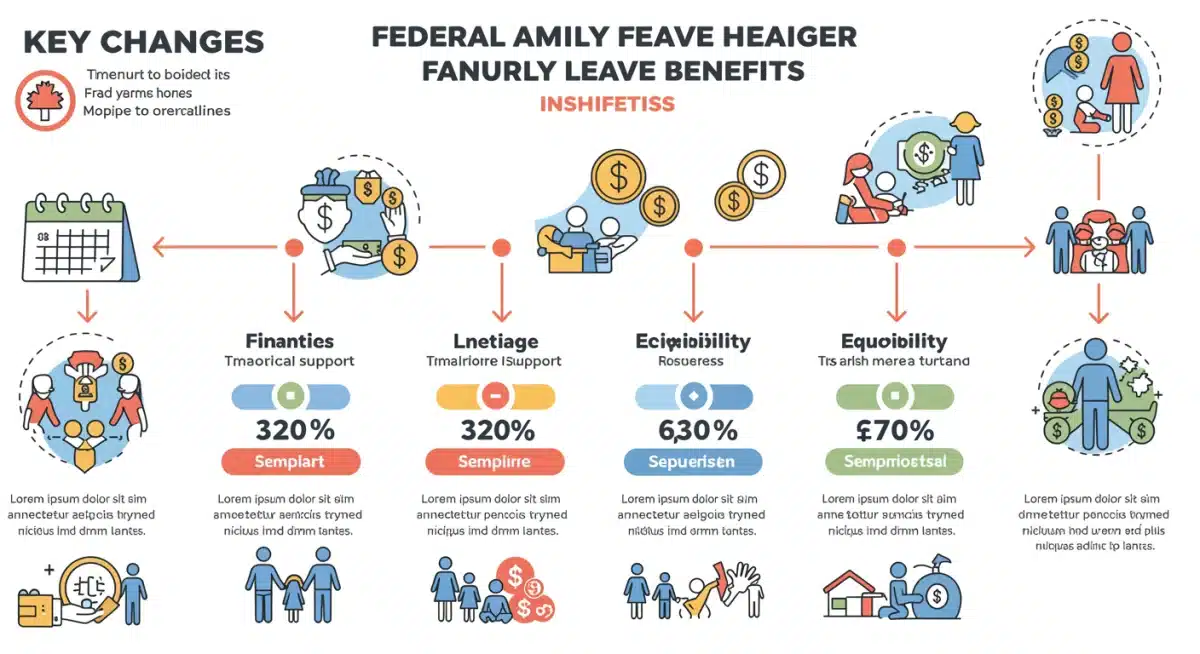
Beyond paid leave, the 2025 program introduces expanded eligibility criteria. The current FMLA requirements, particularly those related to employer size and employee tenure, have historically excluded many workers. The new enhancements are expected to lower these thresholds, bringing more small businesses and part-time workers under the umbrella of federal family leave protections. This broader inclusion reflects an understanding that family care needs are universal, regardless of employment structure.
expanded definitions of family and qualifying events
The enhancements also include a modernized definition of ‘family’ and ‘qualifying events.’ This means that the scope of care for which leave can be taken is broadening. For instance, scenarios such as caring for a wider range of family members beyond immediate parents, spouses, and children – potentially including siblings, grandparents, or domestic partners – may become eligible. Similarly, qualifying events could extend to encompass a broader spectrum of medical emergencies, military family needs, and other unforeseen life circumstances that necessitate time away from work.
- Broader Family Definition: Potentially includes domestic partners, siblings, and grandparents.
- New Qualifying Events: May cover additional medical emergencies or support for military families.
- Increased Leave Duration: Possibility of extended leave periods for certain circumstances.
These changes collectively represent a significant step forward in federal family leave policy. By expanding paid provisions, broadening eligibility, and modernizing definitions, the 2025 enhancements aim to create a more inclusive and supportive environment for American families, ensuring that workers do not have to choose between their jobs and their family responsibilities.
eligibility and application process for 2025
With the significant enhancements coming in 2025, understanding the updated eligibility criteria and the streamlined application process will be crucial for American workers. These changes are designed to make accessing family leave benefits more straightforward and inclusive, reducing barriers that have historically prevented many from utilizing these vital protections.
The most notable shift in eligibility for 2025 is the anticipated reduction in the minimum employment duration and the threshold for employer size. While the exact figures are subject to final legislative details, proposals suggest that employees may qualify for benefits after a shorter period of employment, potentially six months, and that businesses with fewer than 50 employees might also be covered. This expansion is a direct response to feedback highlighting how current FMLA rules exclude a large portion of the workforce, particularly those in small businesses or with less established work histories.
simplified application procedures
The application process itself is also expected to see improvements, moving towards a more centralized and user-friendly system. The goal is to reduce the administrative burden on both employees and employers. This could involve a standardized federal application form, online submission portals, and clearer guidelines for required documentation. The aim is to demystify the process, making it less intimidating for individuals who may already be under stress due to family circumstances.
- Online Portals: Centralized platforms for submitting applications and supporting documents.
- Standardized Forms: Simplified federal forms to reduce confusion and errors.
- Clearer Documentation: Explicit guidelines on what medical or family-related documentation is needed.
Furthermore, there will likely be increased outreach and educational campaigns to inform the public about these changes. The federal government recognizes that the effectiveness of these enhancements hinges on public awareness and understanding. Expect to see resources made available through government websites, community centers, and employer networks to ensure that all eligible individuals are aware of their rights and how to apply for benefits. These proactive measures aim to ensure that the expanded benefits reach those who need them most, simplifying the journey from eligibility to receiving support.
financial implications and benefit calculations
The financial aspect of the 2025 federal family leave enhancements represents one of the most significant advancements. Moving beyond the unpaid nature of traditional FMLA, the new program aims to provide a tangible financial safety net, allowing workers to prioritize family needs without facing severe economic hardship. Understanding how these benefits are calculated and their potential financial implications is key for both employees and employers.
Under the proposed 2025 structure, eligible employees are expected to receive a percentage of their average weekly wages during their approved leave period. While the precise percentage will be determined by final legislation, discussions have centered around a tiered system, potentially offering a higher percentage for lower-income workers to ensure equitable support. This progressive approach is designed to mitigate the disproportionate impact of unpaid leave on vulnerable populations, providing a more robust safety net for those who need it most.
understanding benefit caps and duration
It is also important to note that federal paid leave programs typically include a cap on the maximum weekly benefit amount. This cap ensures the program’s sustainability and prevents excessively high payouts, while still providing meaningful support. Employees should familiarize themselves with these caps, as they will influence the total financial benefit received, especially for higher earners. The duration of paid leave is also a critical factor, with proposals suggesting varying lengths depending on the qualifying event, such as birth, adoption, or caring for a seriously ill family member.
- Wage Replacement Rate: A percentage of average weekly wages, possibly tiered.
- Weekly Benefit Cap: A maximum amount payable per week to ensure program sustainability.
- Leave Duration: Varies based on the qualifying event (e.g., parental leave, caregiver leave).
For employers, these enhancements will likely involve new payroll deductions or contributions to fund the paid leave program, similar to existing state-level paid family leave initiatives. While this may represent an additional administrative layer, the long-term benefits of improved employee retention, morale, and productivity are often cited as strong justifications. Both employees and employers will need to stay informed about the specific funding mechanisms and benefit calculation methodologies as the 2025 program details are fully unveiled to effectively plan and utilize these crucial financial supports.
impact on american families and workplaces
The 2025 federal family leave enhancements are poised to bring about transformative changes for both American families and workplaces. These policy shifts are not merely administrative updates; they represent a fundamental rethinking of how society supports its working population, acknowledging the critical intersection of professional responsibilities and personal life events. The ripple effects are expected to be far-reaching, fostering more inclusive and supportive environments.
For families, the most immediate and profound impact will be the reduction of financial stress during pivotal moments. The introduction of paid leave means that parents can welcome a new child, or individuals can care for an ailing loved one, without the agonizing choice between income and care. This can lead to improved maternal and paternal bonding, better health outcomes for children and sick family members, and overall enhanced family well-being. It also promotes greater gender equity in the workplace, as women, who often bear the brunt of caregiving responsibilities, will have more financial security when taking leave.
workplace benefits and challenges
Workplaces are also set to experience significant shifts. Employers may see an increase in employee morale, loyalty, and retention rates as workers feel more valued and supported. Companies that embrace these changes can position themselves as attractive employers, gaining a competitive edge in recruiting top talent. Furthermore, a more standardized federal program could simplify compliance for businesses operating across multiple states, reducing the complexity of navigating a patchwork of state-specific family leave laws. However, there will also be challenges, particularly for smaller businesses that may need to adjust to new administrative requirements and potential financial contributions.
- Improved Employee Retention: Workers are more likely to return to supportive employers.
- Enhanced Morale: Employees feel valued, leading to increased productivity.
- Reduced Gender Gap: More equitable distribution of caregiving responsibilities.
- Administrative Adjustments: Employers will need to adapt to new program guidelines and reporting.
Ultimately, the 2025 enhancements are expected to cultivate a more compassionate and sustainable work-life ecosystem. By ensuring that workers can attend to family needs without jeopardizing their livelihoods, the federal government is laying the groundwork for a healthier, more productive, and more equitable society. The initial adjustments for businesses will likely be outweighed by the long-term societal and economic benefits of a workforce that is better supported and more engaged.
comparing 2025 federal program with state initiatives
The introduction of enhanced federal family leave programs in 2025 raises important questions about their relationship with existing state-level initiatives. Many states have already implemented their own paid family leave programs, often exceeding the provisions of the traditional FMLA. Understanding how the new federal program will interact with these diverse state laws is crucial for both employees and employers across the nation.
Currently, a growing number of states, including California, New York, New Jersey, and Massachusetts, offer paid family leave benefits that provide partial wage replacement for qualifying events. These state programs vary widely in terms of eligibility, benefit duration, and wage replacement rates. Some are funded through employee payroll deductions, while others involve employer contributions or a combination of both. These state-level initiatives have served as important models and advocacy points for a national paid leave program, demonstrating the feasibility and benefits of such policies.
harmonization and preemption considerations
The 2025 federal enhancements are likely designed to establish a baseline of family leave benefits across the country. The key question will be whether the federal program will preempt existing state laws or if states will be allowed to offer more generous benefits that complement the federal standard. It is anticipated that the federal program will set a minimum standard, allowing states to continue providing more comprehensive or longer-duration benefits if they choose to do so. This approach would ensure that no worker receives less than the federal minimum, while still allowing states to innovate and cater to their specific populations’ needs.
- Federal Baseline: Establishes a minimum standard for paid family leave nationwide.
- State Flexibility: Allows states to maintain or expand upon federal benefits.
- Reduced Complexity: Aims to streamline the overall family leave landscape.
For individuals, this means that those in states with robust paid family leave programs may continue to access those benefits, potentially combining them with federal provisions if applicable or if the state benefits are more favorable. For employers, particularly those operating in multiple states, the federal program could simplify compliance by providing a uniform framework, though they will still need to be aware of and adhere to any more generous state-specific requirements. The goal is to create a more cohesive and comprehensive system that supports American families, leveraging the strengths of both federal and state-level initiatives to ensure greater access and equity in family leave benefits.
preparing for the 2025 federal family leave changes
As the 2025 federal family leave program enhancements draw nearer, proactive preparation is essential for both employees and employers to navigate the new landscape effectively. Understanding what steps to take now can ensure a smooth transition and maximize the benefits for all parties involved. This period of anticipation offers a crucial window for education, planning, and adaptation.
For employees, the first step is to stay informed about the final details of the legislation. Government websites, reputable news sources, and HR departments will be key resources for updated information regarding eligibility, application procedures, and benefit calculations. It is advisable to review personal and family circumstances to anticipate potential needs for leave and to understand how these new federal benefits might apply. Gathering necessary documentation, such as birth certificates or medical records, in advance can also streamline the application process once the program is fully implemented.
employer readiness and policy updates
Employers, on the other hand, face a more complex set of preparatory tasks. This includes a thorough review of existing company leave policies to ensure they align with or exceed the new federal standards. HR departments will need to update employee handbooks, communicate changes clearly to their workforce, and potentially train managers on the new regulations. Furthermore, businesses will need to assess the financial implications of the new program, including any required contributions or payroll adjustments, and integrate these into their budgeting processes. Consulting with legal and HR experts can provide invaluable guidance during this transitional period.
- Policy Review: Update company leave policies to reflect federal changes.
- Employee Communication: Clearly inform staff about new benefits and procedures.
- Manager Training: Educate management on compliance and support for employees.
- Financial Planning: Budget for potential contributions or administrative costs.
Ultimately, preparation involves a commitment to understanding the nuances of the 2025 federal family leave program. By proactively engaging with the upcoming changes, both employees and employers can ensure that they are well-positioned to take full advantage of the enhanced benefits, fostering a more supportive and sustainable environment for American families and the workforce as a whole. This forward-thinking approach will be critical for a successful implementation and long-term positive impact.
| Key Enhancement | Brief Description |
|---|---|
| Paid Leave Provisions | A federal baseline of paid leave for qualifying events, offering partial wage replacement. |
| Expanded Eligibility | Lowered thresholds for employment duration and employer size, covering more workers. |
| Broadened Definitions | Modernized definitions of ‘family’ and ‘qualifying events’ to include more scenarios. |
| Simplified Application | Streamlined federal application process with potential online submission options. |
frequently asked questions about 2025 family leave
The most significant changes include the introduction of paid leave provisions, broader eligibility criteria for more workers, and expanded definitions of ‘family’ and ‘qualifying events.’ These enhancements aim to provide more comprehensive support than previous federal policies.
No, the federal program is expected to establish a baseline of benefits. States with more generous paid family leave laws will likely continue to offer those benefits, potentially complementing or exceeding the federal minimum standards. The goal is harmonization, not full preemption.
Benefits are expected to be calculated as a percentage of an employee’s average weekly wages. There might be a tiered system to offer higher replacement rates for lower-income workers, along with a maximum weekly benefit cap to ensure program sustainability and equitable distribution.
Employees should start preparing now by staying informed about legislative updates, reviewing their personal circumstances, and understanding potential eligibility. Proactive research and gathering necessary documentation can streamline the application process once the program goes into effect in 2025.
Small businesses will likely need to adjust to new administrative requirements and potential financial contributions. However, the enhancements are also expected to improve employee retention and morale, potentially simplifying compliance across states and fostering a more stable workforce.
conclusion
The 2025 federal family leave program enhancements represent a monumental stride towards a more supportive and equitable work-life balance for American families. By introducing paid leave, expanding eligibility, and modernizing definitions, the federal government is addressing critical needs that have long impacted workers’ financial stability and overall well-being. These changes promise to foster healthier families, more engaged workforces, and a more robust national economy. Both employees and employers are encouraged to proactively engage with these forthcoming regulations to maximize the benefits and ensure a smooth transition into this new era of family support.