Social Security Adjustments 2025: Your Payout Outlook

Anticipated Social Security Adjustments 2025 will significantly impact beneficiary payouts, primarily driven by the Cost-of-Living Adjustment (COLA) and broader economic factors influencing retirement planning and financial stability for millions across the United States.
For millions of Americans, Social Security represents a cornerstone of financial stability in retirement. The prospect of Understanding Social Security Adjustments: A 2025 Outlook on Your Payouts is therefore not merely an academic exercise but a vital part of personal financial planning. As we approach 2025, many are keenly interested in how these adjustments will shape their future benefits, particularly given the ever-evolving economic landscape. What changes can beneficiaries anticipate, and how will these affect their monthly checks?
The Cost-of-Living Adjustment (COLA) in Focus
The Cost-of-Living Adjustment, or COLA, is perhaps the most anticipated annual change for Social Security beneficiaries. Designed to help Social Security benefits keep pace with inflation, COLA ensures that the purchasing power of your benefits doesn’t erode over time. Understanding how COLA is calculated and its potential impact for 2025 is critical for anyone relying on these payments.
COLA is determined by the increase in the Consumer Price Index for Urban Wage Earners and Clerical Workers (CPI-W) from the third quarter of the previous year to the third quarter of the current year. If there’s no increase, there’s no COLA. This mechanism directly links your future payouts to broader economic trends, specifically inflation. While beneficial, the calculation method sometimes draws criticism for not fully reflecting the spending patterns of seniors.
How COLA is Calculated
The calculation of COLA is a precise process, rooted in economic data. The Social Security Administration (SSA) reviews the CPI-W data from July, August, and September. The average of these three months is then compared to the average of the same three months from the prior year. The percentage increase, if any, becomes the COLA for the following year. This method ensures a standardized approach, though its responsiveness to real-time economic shifts can be a point of debate.
- Data Source: Consumer Price Index for Urban Wage Earners and Clerical Workers (CPI-W).
- Measurement Period: Third quarter (July, August, September) comparison year-over-year.
- Impact: Directly determines the percentage increase in Social Security benefits for the upcoming year.
For 2025, early projections and economic forecasts will play a significant role in shaping expectations for COLA. Factors such as energy prices, food costs, and housing inflation will all contribute to the CPI-W, and consequently, to the final COLA percentage. Beneficiaries should monitor these economic indicators closely as the year progresses.
In essence, COLA serves as a vital safeguard for the financial well-being of retirees and other beneficiaries. While its precise figure for 2025 remains to be seen, its fundamental role in preserving purchasing power makes it a central component of any discussion regarding Social Security adjustments.
Eligibility and Benefit Qualification Thresholds
Beyond the annual COLA, other adjustments to Social Security involve eligibility requirements and benefit qualification thresholds. These aspects are equally important for both current and prospective beneficiaries, as they dictate who receives benefits and under what circumstances. The rules surrounding work credits, age requirements, and earnings limits are subject to periodic review and potential modification, impacting many Americans.
To qualify for Social Security retirement benefits, individuals generally need to earn 40 work credits. These credits are accumulated over a working lifetime, with a maximum of four credits earned per year. The amount of earnings required for one credit typically increases each year, reflecting national average wage growth. For 2025, this earnings threshold will likely see another adjustment, requiring slightly more income to earn a credit.
Understanding Work Credits
Work credits are fundamental to Social Security eligibility. They are the building blocks that determine whether an individual, or their family members, can receive benefits. The system ensures that those who have contributed to the system through payroll taxes for a sufficient period are eligible for its protections. The quarterly earnings threshold for a credit is a key figure that changes annually.
- Earning Credits: Up to four credits can be earned per year.
- Required Credits: Most people need 40 credits (10 years of work) for retirement benefits.
- Annual Adjustment: The amount of earnings needed for a credit increases each year.
Furthermore, the full retirement age (FRA) remains a critical factor. While some individuals can claim benefits as early as age 62, doing so results in a permanent reduction in monthly payments. The FRA varies based on your birth year, and understanding your specific FRA is crucial for maximizing your benefits. There are no anticipated changes to the FRA schedule for 2025, but it’s always wise to confirm your specific age.
Additionally, earnings limits apply to those who claim Social Security benefits before their full retirement age and continue to work. If you earn above a certain limit, your benefits may be temporarily reduced. These limits are also adjusted annually, reflecting changes in the national average wage index. For 2025, expect these earnings limits to be slightly higher, allowing beneficiaries to earn more without impacting their benefits.
Maximum Taxable Earnings and Benefit Caps
Another significant area of adjustment concerns the maximum taxable earnings, often referred to as the Social Security wage base, and the overall benefit caps. These figures have a direct impact on both high-income earners and those with substantial work histories, influencing how much they contribute to the system and the maximum amount they can receive in benefits.
The maximum taxable earnings amount is the cap on earnings subject to Social Security taxes. Earnings above this limit are not taxed for Social Security purposes, and they do not count towards future benefit calculations. This limit is adjusted annually based on the national average wage index (NAWI). For 2025, it is highly probable that this wage base will increase, meaning high-income earners will pay Social Security taxes on a larger portion of their income.
Impact on High Earners
The increase in the maximum taxable earnings directly impacts individuals with higher incomes. It means they will contribute more to Social Security each year, potentially increasing the overall solvency of the system. While it can reduce take-home pay for these individuals, it also reflects their higher earning capacity within the economy.
- Increased Contributions: Higher wage base means more payroll taxes for high earners.
- Benefit Calculation: Only earnings up to the wage base are considered for benefit computation.
- System Solvency: Contributes to the overall financial health of Social Security.
Similarly, there is a maximum monthly benefit amount that an individual can receive from Social Security. This cap is also adjusted annually and is primarily relevant for individuals who have consistently earned at or above the maximum taxable earnings over their working lives. For 2025, this maximum benefit is expected to increase, reflecting the higher wage base and COLA adjustments.
These caps and thresholds are essential components of the Social Security system, designed to ensure both fairness and fiscal responsibility. While they primarily affect higher-income individuals, understanding them provides a complete picture of the system’s mechanics for all beneficiaries.
Factors Influencing 2025 Adjustments
Several economic and demographic factors converge to shape the 2025 Social Security adjustments. These influences extend beyond just inflation, encompassing broader economic health, labor market dynamics, and even legislative considerations. A holistic view of these factors offers a more accurate prediction of what beneficiaries can expect.
Inflation, as measured by the CPI-W, remains the primary driver for COLA. However, other forces are at play. Wage growth, for instance, impacts the maximum taxable earnings and the earnings required for work credits. A robust labor market with increasing wages generally translates to higher thresholds and, potentially, higher future benefits for those still working. Conversely, stagnant wage growth can limit these adjustments.
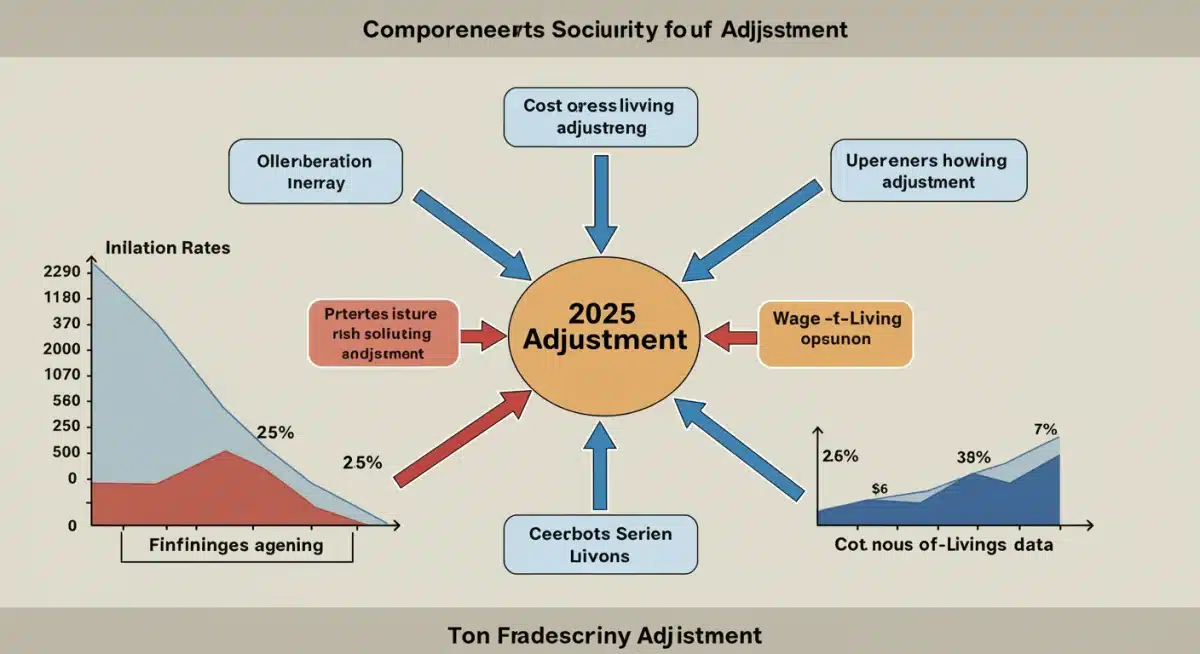
Demographic shifts also play a subtle but significant role. The ratio of workers contributing to the system versus beneficiaries receiving payments influences the long-term solvency of Social Security. While not directly impacting annual adjustments, these trends inform broader policy discussions and potential future reforms that could eventually affect how benefits are calculated or distributed.
Economic Indicators to Watch
Keeping an eye on key economic indicators can provide clues about the likely direction of 2025 adjustments. Beyond the CPI-W, metrics such as the unemployment rate, GDP growth, and interest rates offer insights into the overall economic environment that will shape the SSA’s decisions.
- Inflation Rates: Directly impacts the COLA calculation.
- Wage Growth: Influences maximum taxable earnings and work credit thresholds.
- Labor Market Health: A strong job market supports the Social Security trust funds.
Furthermore, any potential legislative changes, although not currently anticipated to significantly alter 2025 adjustments, are always a factor. Congress has the authority to modify Social Security laws, and ongoing debates about the system’s long-term financial health could lead to future reforms. For the immediate 2025 outlook, however, economic data will be the dominant influence.
In summary, the 2025 adjustments will be a culmination of various economic forces, with inflation and wage growth taking center stage. Beneficiaries and future retirees should stay informed about these indicators to best prepare for their financial future.
Impact on Retirement Planning and Financial Strategies
Understanding the anticipated 2025 Social Security adjustments is not just about knowing your future benefit amount; it’s about integrating this knowledge into your broader retirement planning and financial strategies. These adjustments can influence everything from budgeting to investment decisions, making informed preparation essential for a secure retirement.
For current retirees, a higher COLA means increased purchasing power, which can help offset rising costs of living, especially for essentials like healthcare and housing. This can alleviate some financial pressure and potentially reduce the need to draw down other retirement savings as quickly. Conversely, a lower-than-expected COLA might necessitate a re-evaluation of spending habits or a deeper reliance on personal savings.
Adjusting Your Budget
Retirees should proactively adjust their household budgets based on the expected COLA. If your monthly income increases, you might have more flexibility for discretionary spending or for building an emergency fund. If the increase is modest, it’s crucial to prioritize expenses and ensure your budget remains sustainable.
- Re-evaluate Expenses: Align your budget with updated benefit amounts.
- Healthcare Costs: Factor in potential increases in Medicare premiums, which can offset COLA gains.
- Savings Strategy: Adjust draw-down rates from other retirement accounts if benefits change significantly.
For those still planning for retirement, the 2025 adjustments offer valuable insights. Understanding the trajectory of the maximum taxable earnings and potential future benefit caps can help you project your own Social Security income more accurately. This information can then be used to refine your savings goals, determine your desired retirement age, and assess the adequacy of your other retirement vehicles, such as 401(k)s and IRAs.
Furthermore, these adjustments highlight the importance of not relying solely on Social Security for retirement income. While a crucial component, it’s designed to replace only a percentage of pre-retirement earnings. Diversifying your retirement portfolio and having multiple income streams remains a prudent strategy, regardless of the annual Social Security adjustments.
Navigating Medicare Premiums and Social Security
A critical consideration for many Social Security beneficiaries is the intricate relationship between their benefits and Medicare premiums. Often, increases in Social Security payouts can be partially or entirely offset by rising Medicare Part B premiums, a phenomenon known as the “hold harmless” provision. Understanding this dynamic is crucial when evaluating the net impact of 2025 adjustments on your take-home benefits.
The “hold harmless” provision generally prevents Medicare Part B premiums from increasing by more than the dollar amount of a beneficiary’s Social Security COLA. This ensures that most beneficiaries do not see a reduction in their net Social Security check from one year to the next due to Medicare premium hikes. However, this protection doesn’t apply to everyone, and certain circumstances can lead to a higher premium impact.
Who is Affected?
While the hold harmless provision protects a majority, it doesn’t cover all beneficiaries. Individuals who are new to Medicare, those who don’t have their Part B premiums deducted from their Social Security checks, and high-income earners subject to the Income-Related Monthly Adjustment Amount (IRMAA) may experience the full weight of Medicare premium increases, regardless of their COLA.
- Hold Harmless Protection: Most beneficiaries are protected from premium increases exceeding their COLA.
- IRMAA Impact: High-income earners pay higher Part B premiums and are not covered by hold harmless for the IRMAA portion.
- New Beneficiaries: Those new to Medicare may face full premium increases.
For 2025, projections for Medicare Part B premiums will be released closer to the end of the year. These projections, combined with the Social Security COLA, will determine the actual net increase in benefits for most individuals. It is not uncommon for a significant portion, or even all, of the COLA increase to be absorbed by higher Medicare costs, especially for those in certain income brackets or circumstances.
Therefore, when assessing the 2025 Social Security adjustments, it’s vital to consider them in conjunction with potential Medicare premium changes. A seemingly favorable COLA might yield a smaller net increase once healthcare costs are factored in, underscoring the need for careful financial planning and budgeting.
Seeking Expert Advice and Resources
Navigating the complexities of Social Security adjustments can be challenging, and while this article provides a comprehensive overview, individual situations often require personalized guidance. Seeking expert advice and utilizing available resources can help ensure you make the most informed decisions regarding your benefits and future financial security.
Financial advisors specializing in retirement planning can offer tailored strategies based on your specific income, assets, and goals. They can help you understand how potential 2025 adjustments might affect your overall financial picture, including tax implications, investment strategies, and long-term budgeting. Their expertise can be invaluable in crafting a robust retirement plan that incorporates Social Security effectively.
Official Resources for Information
The Social Security Administration (SSA) is the primary and most authoritative source for information regarding your benefits. Their official website offers a wealth of resources, including your personal Social Security statement, benefit calculators, and detailed publications on various aspects of the program. Staying connected with these official channels is crucial for accurate and up-to-date information.
- SSA Website: Your primary source for official information and personalized statements.
- Benefit Calculators: Tools to estimate future benefits based on your earnings history.
- Local SSA Offices: For in-person assistance and specific questions about your account.
Additionally, various non-profit organizations and government agencies offer free resources and counseling services for seniors and those planning for retirement. These resources can provide unbiased information on Social Security, Medicare, and other benefit programs, helping you to understand your options and rights. Attending webinars or workshops can also be beneficial.
In conclusion, while understanding the broad strokes of 2025 Social Security adjustments is important, proactive engagement with official resources and, if necessary, financial professionals, can provide the clarity and confidence needed to secure your financial future. Don’t hesitate to seek out the information and support available to you.
| Key Adjustment Area | Brief Description of 2025 Outlook |
|---|---|
| Cost-of-Living Adjustment (COLA) | Anticipated increase based on CPI-W, impacting purchasing power for beneficiaries. |
| Eligibility & Work Credits | Earnings required for work credits likely to increase, affecting qualification for benefits. |
| Maximum Taxable Earnings | Expected to rise, increasing Social Security contributions for high-income earners. |
| Medicare Premium Offset | COLA gains may be partially or fully offset by rising Medicare Part B premiums for some. |
Frequently Asked Questions About 2025 Social Security Adjustments
The primary factor influencing the 2025 Social Security Cost-of-Living Adjustment (COLA) is the Consumer Price Index for Urban Wage Earners and Clerical Workers (CPI-W). This index measures inflation, and its increase from the third quarter of 2023 to the third quarter of 2024 will determine the COLA percentage for 2025.
For most beneficiaries, the “hold harmless” provision will prevent Medicare Part B premiums from increasing more than their Social Security COLA. However, certain groups, such as high-income earners or new Medicare enrollees, may see their COLA increase partially or fully absorbed by higher Medicare costs.
Work credits are essential for Social Security eligibility. You generally need 40 credits (10 years of work) to qualify for retirement benefits. The amount of earnings needed to earn one credit is adjusted annually, and this threshold is expected to increase in 2025, impacting how quickly new workers accrue credits.
The maximum taxable earnings limit is the amount of income subject to Social Security taxes. It is adjusted annually based on the national average wage index. For 2025, this limit is expected to increase, meaning high-income earners will pay Social Security taxes on a larger portion of their earnings.
For personalized information, the official Social Security Administration (SSA) website is your best resource. You can log in to your my Social Security account to view your earnings history, estimate future benefits, and access detailed publications relevant to your specific situation and projected 2025 benefits.
Conclusion
The journey of Understanding Social Security Adjustments: A 2025 Outlook on Your Payouts reveals a multifaceted system influenced by economic indicators, demographic shifts, and legislative frameworks. While the precise figures for the 2025 COLA, maximum taxable earnings, and other thresholds will be finalized later in the year, anticipating these changes is a crucial step in proactive financial planning. Beneficiaries and future retirees must remain informed, utilizing official resources and expert advice to navigate these adjustments effectively. By doing so, individuals can better prepare for their financial future, ensuring Social Security continues to provide the vital support it was designed for.